December 12, 2022

Control of cassava mealybug Phenacoccus manihoti using NECO 50EC biopesticide | IJB 2022

Control of cassava mealybug Phenacoccus manihoti (Homoptera: Pseudococcidae) using NECO 50EC biopesticide in Grand Lahou (Côte d’Ivoire)  Yéboué N’guessan Lucie, Tano Djè Kevin Christian, Tra Bi Crolaud Sylvain, Senan Soro, Yao Tano Key Words: BiopesticideCassavaCôte d’IvoireNECO 50 ECPhenacoccus manihoti

Author

Yéboué N’guessan Lucie  
Improvement and Agricultural Production Laboratory, UFR Agroforestry, Jean Lorougnon Guédé University, BP 150 Daloa, Côte d’Ivoire    
 
Tano Djè Kevin Christian 
Improvement and Agricultural Production Laboratory, UFR Agroforestry, Jean Lorougnon Guédé University, BP 150 Daloa, Côte d’Ivoire 
 
Tra Bi Crolaud Sylvain  
Improvement and Agricultural Production Laboratory, UFR Agroforestry, Jean Lorougnon Guédé University, BP 150 Daloa, Côte d’Ivoire 
 
Senan Soro
Switzerland Center for Scientific Research, 01 BP 1303 Abidjan 01, Abidjan-Côte d’Ivoire

Yao Tano
Plant Protection Laboratory, UFR Science of Nature, Nangui Abrogoua University, 02 BP 801
Abidjan 02, Côte d’Ivoire

 Journal Name

International Journal of Biosciences | IJB

 Publisher Name

International Network For Natural Sciences | INNSpub

 Abstract

Cassava (Manihot esculenta Crantz) is a food crop with tuberous roots that plays an important role in feeding populations. The need to control cassava pests led to testing the effect of the biopesticide NECO 50 EC on Phenacoccus manihoti in a plot of the city of Grand-Lahou. The effectiveness of the biopesticide NECO 50 EC was tested on larvae and adults of P. manihoti, in comparison with a conventional insecticide K-OPTIMAL 35 EC. Dilutions gave 5 respective concentrations of NECO 50 EC: 8.33 g/l; 4.54g/l; 3.12g/l; 2.38 g/l and 1.92 g/l, and a concentration of 0.093 g/l for the control insecticide. Spraying of cassava plants infested with mealybugs was undertaken and observations were made 24 hours, 48 hours and 72 hours after treatment. On the larvae, the highest rate (92.07 ± 0%) is obtained at a concentration of 8.33 g/l for NECO and 98.51% for the control insecticide. In adults for NECO the highest rate (62.50 ± 0%) is obtained at the concentration of 8.33 g/l and 96.17% for the control insecticide. The biopesticide NECO 50 EC could be used as an alternative to the excessive use of synthetic insecticides to reduce the damage of the pest P. manihoti. Check out more by folllowing the link Control of cassava mealybug Phenacoccus manihoti (Homoptera: Pseudococcidae) using NECO 50EC biopesticide in Grand Lahou (Côte d’Ivoire)


 Cassava (Manihot esculenta Crantz) is a food crop with tuberous roots that plays an important role in feeding populations. The need to control cassava pests led to testing the effect of the biopesticide NECO 50 EC on Phenacoccus manihoti in a plot of the city of Grand-Lahou. The effectiveness of the biopesticide NECO 50 EC was tested on larvae and adults of P. manihoti, in comparison with a conventional insecticide K-OPTIMAL 35 EC. Dilutions gave 5 respective concentrations of NECO 50 EC: 8.33 g/l; 4.54g/l; 3.12g/l; 2.38 g/l and 1.92 g/l, and a concentration of 0.093 g/l for the control insecticide. Spraying of cassava plants infested with mealybugs was undertaken and observations were made 24 hours, 48 hours and 72 hours after treatment. On the larvae, the highest rate (92.07 ± 0%) is obtained at a concentration of 8.33 g/l for NECO and 98.51% for the control insecticide. In adults for NECO the highest rate (62.50 ± 0%) is obtained at the concentration of 8.33 g/l and 96.17% for the control insecticide. The biopesticide NECO 50 EC could be used as an alternative to the excessive use of synthetic insecticides to reduce the damage of the pest P. manihoti.

Reference

Abbott WS. 1925. A method of computing the effectiveness of an insecticide. Journal of Economic Entomology 18, 265- 267. http://dx.doi.org/10.1093/jee/18.2.265a

Akpingny KL, Koulou N. 2017. Fiche technicoéconomique du manioc. Agence National d’Appui au Développement Rural (ANADER), p 8.

Begon M, Harper LJ, Townsend CR. 1990. Ecology: individual population and communities. Boston, 2nd Edition Oxford: Blackwell Scientific Publications, p 945.

Braima J, Yannick J, Neuenschwander P, Cudjoe A, Modder W, Echendu N, Toko M. 2000. Lutte contre les ravageurs du manioc. International Institute of Tropical Agriculture (IITA), Cotonou, Benin, p 38.

Calatayud PA, Le Ru B. 1997. La lutte contre la cochenille du manioc en Afrique. Cahiers de la Recherche Développement 43, 59-66.

Cloyd R, Chiasson H. 2007. Activity of an essential oil derived from Chenopodium ambrosioides on Greenhouse Insect Pests. Journal of Economic Entomology 100, 459-466. https://doi.org/10.1093/jee/100.2.459

Enete AA. 2009. Middlemen and smallholder farmers in cassava marketing in Africa. Tropicultura 27(1), 40-44. http://www.tropicultura.org/text/v27n1/40.pdf

Enete AA, Igbokwe EM. 2009. Cassava market participation decisions of producing households in Africa. Tropicultura 27(3), 129-136. http://www.tropicultura.org/text/v27n3/129.pdf

FAOSTAT. 2017. Crop Production in 2014: Cassava Data [Internet]. Available from. http://faostat3.fao.org

FAO. 2014. FAOSTAT (Données de l’alimentation et de l’agriculture). http://www.fao.org/faostat/fr/#compare.

FAO. 1996. Annuaire production: 1995. Rome, Italie, FAO, p 235.

Finney DJ. 1971. Probit analysis. 3rd. Edition, Cambridge University Press, p 33. https://doi.org/10.1002/bimj.19720140111

Gonzalez CA, Reina M, Diaz CE, Fraga, BM, Santana-Meridas O. 2013. Natural Product-Based Biopesticides for Insect Control. In: Reedijk, J., Ed. Elsevier Reference Module in Chemistry, Molecular Sciences and Chemical Engineering. Waltham, MA, Elsevier. 01-Nov-13. http://dx.doi.org/10.1016/B978-0-12-409547-2.02770-0

Gueye MT, Seck D, Wathelet JP, Lognay G. 2011. Lutte contre les ravageurs des stocks de céréales et de légumineuses au Sénégal et en Afrique occidentale: synthèse bibliographique. Biotechnology, Agronomy and Society and Environment 15(10), 183-194. https://popups.uliege.be/1780-4507/index.php?id=17030&file=1&pid=7108

Hénault-Ethier L. 2015. Health and environmental impacts of pyrethroid insecticides: What we know, what we don’t know and what we should do about it. Executive summary and Scientific Literature Review, Equiterre, Montréal, Canada, p 68. https://legacy.equiterre.org/sites/fichiers/health_and_environmental_impacts_of_pyrethroid_insecticides_full_report_en.pdf

Herren HR. 1987. Africa-wide Biological Control Project of Cassava Pests. In: Symposium XI: Africa-wide Biological Control Programme of Cassava Pests. December 1987, p 837-840. International Journal of Tropical Insect Science , Volume 8 , Issue 4-5-6: Recent Advances in Research on Tropical Entomology ,  https://doi.org/10.1017/S174275840002302X

Howeler R, Lutaladio N, Thomas G. 2013. Save and Grow: Cassava. A guide to sustainable production intensification. FAO, Rome (Italy). Plant Production and Protection Div, p 129.

INS. 2015. RGPH 2015_Répetoire des localités: Carte du département de grand-lahou, p 15-16.

Isman MB. 1997. Neem insecticides. Pesticide Outlook 8(5), 32-38.

Johnson F, Ouosso KR, Kanko C, Tonzibo ZF, Foua-bi K, Tano Y. 2018. Bioefficacité des huiles essentielles de trois espèces végétales (Ocimum gratissimum, Ocimum canum) et (Hyptis suaveolens), de la famille des Labiées dans la lutte contre Sitophilus zeamais. European Journal of sciences Research 150(3), 273-284. https://www.europeanjournalofscientificresearch.com/issues/PDF/EJSR_150_3_03.pdf

Johnson F, Seri-Kouassi B, Aboua LRN, Foua-Bi K. 2006. Utilisation de poudres et d’extraits totaux issus de plantes locales des genres Ocimum sp. et Mentha sp. comme biopesticides dans la lutte contre Callosobruchus maculatus Fab. Agronomie Africaine 18(3), 221-233. http://dx.doi.org/10.4314/aga.v18i3.1694

Kassi FM, Badou OJ, Tonzibo ZF, Salah Z, Amari LDGE, Koné D. 2014. Action du fongicide naturel NECO contre la cercosporiose noire (Mycosphaerella fijiensis Morelet) chez le bananier plantain (AAB) en Côte d’Ivoire. Journal of Applied Biosciences 75, 6183-6191. http://dx.doi.org/10.4314/jab.v75i1.3

Kadri A, Zakari Moussa O, Yacouba SA, Abdou HKK. Karimoune L. 2013. Gestion intégrée de Maruca vitrata (Fabricius, 1787) et Megalurothrips sjostedti (Trybom, 1908), deux ravageurs majeurs du niébé au Niger. International Journal of Biological and Chemical Sciences 7(6), 2549- 2557. http://dx.doi.org/10.4314/ijbcs.v7i6.29

Konan KS, Kouassi KL, Kouamé KI, Kouassi AM, Gnakri D. 2013. Hydrologie et hydrochimie des eaux dans la zone de construction du chenal du port de pêche de Grand-Lahou, Côte d’Ivoire. International Journal of Biological and Chemical Sciences 7(2), 819-831. http://dx.doi.org/10.4314/ijbcs.v7i2.37

Kouninki H, Haubruge E, Noudjou FE, Lognay G, Malaise F, Ngassoum MB, Goudoum A, Mapongmetsem PM, Ngamo LS, Hance T. 2005. Potentiel use of essential oils from Cameroon applied as fumigant or contact insecticides against Sitophilus zeamais Motsch. (Coleoptera: Curculionidae). Communications in Agricultural and Applied Biological Sciences 70(40), 787-792. https://www.ajfand.net/Volume7/No5/Kouninki2145.pdf

Mabrouk A, El-Sharkawy MA. 1993. Drought-tolerant Cassava for Africa, Asia, and Latin America: Breeding projects work to stabilize productivity without increasing pressures on limited natural resources 43(7), 441-451. https://doi.org/10.2307/1311903

Matile-Fererro D. 1976. Les cochenilles nuisibles au manioc en République Populaire du Congo. Rapport de mission : Muséum d’histoire naturelle (Paris, France), p 30.

Monfankye R. 2014. The management of field pests on Cowpea (Vigna unguiculata (L.) Walp) using botanicals [tobacco (Nicotiana tabacum) leaves, neem (Azadirachta indica) leaves, ginger (Zingiber officinale) rhizomes and onion (Allium cepa) bulbs]. Master of Science (Environmental Science), Kwame Nkrumah University of Science and Technology, Ghana, p 85.

N’zué B, Zohouri GP, Djédji C, Tahouo O. 2013. Bien cultiver le manioc en Côte-d’Ivoire. Direction de la recherche scientifique et de l’appui au développement – Direction des innovations et des systèmes d’information du CNRA (Centre National de Recherche Agronomique), Abidjan (Côte d’Ivoire), p 4.

Ossey CL, Aboua LRN, Tano DKC, Assi ANM, Obodji A. 2018. Effet insecticide, anti-appétant et répulsif des extraits aqueux de quatre plantes locales sur les adultes de O. mutabilis Sahlberg (Coleoptera: Chrysomelidae) au sud de la Côte d’Ivoire. Afrique SCIENCE 1(5), 50-64. http://www.afriquescience.net/PDF/14/5/5.pdf

Ouédraogo I, Sawadogo A, Nebié RCH, Dakouo D. 2016. Evaluation de la toxicité des huiles essentielles de Cymbopogon nardus (L) et Ocimum gratissimum (L) contre Sitophilus zeamais Motsch et Rhyzopertha dominica F, les principaux insectes nuisibles au maïs en stockage au Burkina Faso. International Journal Biological and Chemical Sciences 10(2), 695-705. http://dx.doi.org/10.4314/ijbcs.v10i2.20

Priestley CM, Williamson EM, Wafford KA, Sattelle DB. 2003. Thymol, a constituent of thyme essential oil, is a positive allosteric modulator of human GABA receptors and a homo-oligomeric GABA receptor from Drosophila melanogaster. British Journal of Pharmacology 140, 1363-1372. https://doi.org/10.1038/sj.bjp.0705542

Silvestre P, Arraudeau M. 1983. Le manioc. Maisonneuve et Larose Paris, France /ACCT, Coll. « Techniques agricoles et Productions tropicales », 32 p 262.

Tano DKC, Aboua LRN, Séri-Kouassi BPh, Koua KH. 2012. Evaluation of the insecticidal activity of aqueous extracts of five plants on Coelaenomenodera lameensis Berti and Mariau (Coleoptera: Chrysomelidae) pest of oil palm (Elaeis guineensis Jacq.). International Journal of AgriScience 2(2), 120-135.

Tano DKC, Tra Bi CS, Kouassi KA. Ossey CL, Soro S. 2019. Incidences des attaques de Podagrica decolorata Duvivier 1892 (Coleoptera: Chrysomelidae) sur la culture du gombo et contrôle de ces adultes au moyen du biopesticide NECO 50 EC (Daloa, Côte d’Ivoire). Journal of Applied BioSciences 143, 14692-14700. https://dx.doi.org/10.4314/jab.v143i1.7

Tata-Hangy K. 1995. La lutte contre la cochenille du manioc Phenacoccus manihoti MATILE-FERRERO et l’acarien vert Mononychellus tanajoa BONDAR au Zaïre : Bilan des recherches 13(2), 43-49.

Tounou Ak, Agboka K, Bakouma Be, Aadom M, Adjevi Akm, Sanda K. 2018. Etude comparée de l’efficacité de la cyperméthrine et deux bioinsecticides, Beauveria bassiana et suneem contre l’altise du gombo, Podagrica spp (Coleoptera: Chrysomelidae). Journal Biological and Chemical Sciences 12(1), 491-500. https://dx.doi.org/10.4314/ijbcs.v12i1.38

Silvestre P, Arraudeau M. 1983. Le manioc. Paris, Maisonneuve et Larose/ACCT, Coll. «Techniques agricoles et Productions tropicales» 32, p 262. https://www.cabi.org/gara/mobile/FullTextPDF/Pre2000/19830750680.pdf

December 11, 2022

Valorization of the duckweed (Spirodela polyrhyza) in the feeding of mono sex male fry of Oreochromis niloticus | IJAAR 2021

Zootechnical performance and economic profitability

 Author Name

  • Sènan Maxime Boris Djossou

    (School of Aquaculture, National University of Agriculture, Kétou, Benin)

  • Diane N. S. Kpogue Gangbazou

    (School of Aquaculture, National University of Agriculture, Kétou, Benin) 

  •  Arsène F. M. D'almeida

    (Institut National des Recherches Agricoles du Bénin, Centre de Recherches Agricoles d'Agonkanmey, Recette Principale Cotonou, Benin)

  •  André B. Aboh

    (Ecole de Gestion et d'Exploitation des Systèmes d'Elevage, Kétou, Benin)

  •  Elie Montchowui

    (School of Aquaculture, National University of Agriculture, Kétou, Benin)

  •  Emile D. Fiogbe

    (Unité de Recherches sur les Zones Humides, Département de Zoologie, Faculté des Sciences et
    Techniques, Université d'Abomey, Calavi, Cotonou, Benin)

Journal Name

International Journal of Agronomy and Agricultural Research | IJAAR 

Publisher

International Network For Natural Sciences | INNSpub

Abstract

In order to evaluate the effect of Spirodela polyrhiza using in diets of Oreochromis niloticus fingerlings, an experiment was conducted on the farm “Awara” in the village of Agongo in Sèmè – Kpodji during 70 days. The initial average weight of fry is about 1g. The stocking density was 13 fry / m². Three experimental diets made with local by-products were tested: T0 (0% S. polyrhiza Meal), T1 (5% S. polyrhiza Meal) and T2 (mixed feed composed of 70% T0 and 30% fresh S. polyrhiza). At the end of the experiment, the survival rate was 100% for all treatments. The best zootechnical parameters were obtained with T1 with a final average weight of 11.67 ± 2.52 g and a consumption index of 1.17 ± 0.30. The highest gross profit margin was also obtained with T1. The lowest economic profitability was obtained. Check out more Valorization of the duckweed (Spirodela polyrhyza) in the feeding of mono sex male fry of Oreochromis niloticus: Zootechnical performance and economic profitability

December 5, 2022

Research paper | Anthropogenic noise reduces bird species richness and diversity along a Rur-urban gradient By JBES 2022


Author Name

Garima Tiwari and Fergus Mark Anthony

Journal Name

Journal of Biodiversity and Environmental Sciences | JBES

Publisher Name

International Network For Natural Sciences | INNSpub

Abstract

Urbanization is increasing rapidly in all parts of the world to accommodate the increasing human population but it is having a drastic effect on native flora and fauna. The present study was carried out across a three stage urbanization gradient in and around the city of Bilaspur, Chhattisgarh. Observations were made from September 2019 to February 2021 at the selected three sites during COVID 19 pandemic. Point count method was used for bird surveys and Sound pressure (Noise) measurements were made across the three selected sites. The Avian diversity was measured by total species richness, Fisher’s alpha diversity index and Shannon-Wiener diversity index. The Urban centre recorded the highest sound pressure and lowest Avian species richness but as we moved away from the urban centre the noise levels reduced and the avain species richness increased towards the rural areas. This is mainly due to many avian species avoiding urban areas because of increasing noise levels. We also found that the urban bird community is dominated by a few species whereas the rural bird community was much more diverse. To get the full articles, follow the link Anthropogenic noise reduces bird species richness and diversity along a Rur-urban gradient: A case study from a city in central India during nationwide lockdown amid COVID-19

Anthropogenic noise reduces bird species richness and diversity along a Rur-urban gradient

Reference

Arévalo JE, Newhard K. 2011. Traffic noise affects forest bird species in a protected tropical forest. Revista de Biología Tropical 59(2), 969-980.

Bibby CJ, Burgess ND, Hillis DM, Hill DA, Mustoe S. 2000. Bird census techniques. Elsevier.

Blair RB, Launer AE. 1997. Butterfly diversity and human land use: Species assemblages along an urban gradient. Biological conservation 80(1), 113-125.

Blair RB. 1996. Land use and avian species diversity along an urban gradient. Ecological applications 6(2), 506-519.

Blair RB. 2001. Birds and butterflies along urban gradients in two ecoregions of the United States: is urbanization creating a homogeneous fauna? In Biotic homogenization (pp. 33-56). Springer, Boston, MA.

Brackenbury JH. 1979. Power capabilities of the avian sound-producing system. Journal of Experimental Biology 78(1), 163-166.

Brumm H. 2004. The impact of environmental noise on song amplitude in a territorial bird. Journal of animal ecology 73(3), 434-440.

Catchpole CK, Slater PJ. 2003. Bird song: biological themes and variations. Cambridge university press.

Census of India. 2011. Population Statistics. Directorate of Census Operations in Chhattisgarh, Census of India 2011.

De Moura LN, Vielliard JM, Da Silva ML. 2010. Seasonal fluctuation of the Orange-winged Amazon at a roosting site in Amazonia. The Wilson Journal of Ornithology 122(1), 88-94.

Galushin VM. 1971. A huge urban population of birds of prey in Delhi India. Ibis 113(4), 522-522.

Garaffa PI, Filloy J, Bellocq MI. 2009. Bird community responses along urban–rural gradients: Does the size of the urbanized area matter. Landscape and Urban Planning 90(1-2), 33-41.

Halfwerk W, Holleman LJ, Lessells CKM, Slabbekoorn H. 2011. Negative impact of traffic noise on avian reproductive success. Journal of applied Ecology, 48(1), 210-219.

Hunter P. 2007. The human impact on biological diversity: How species adapt to urban challenges sheds light on evolution and provides clues about conservation. EMBO reports 8(4), 316-318.

Jennings V, Larson L, Yun J. 2016. Advancing sustainability through urban green space: Cultural ecosystem services, equity, and social determinants of health. International Journal of environmental research and public health 13(2), 196.

Jokimäki J. 1999. Occurrence of breeding bird species in urban parks: effects of park structure and broad-scale variables. Urban Ecosystems 3(1), 21-34.

Kale M, Ferrante M, Dudhe N, Kasambe R, Trukhanova IS, Ivanova T, Lövei GL. 2018. Nestedness of bird assemblages along an urbanisation gradient in Central India. Journal of Urban Ecology 4(1), juy 017.

Konadath S, Mahadeva A, Chatni S. 2019. Noise measurement across different land-use patterns. Journal of Indian Speech Language & Hearing Association 33(2), 55.

Marzluff JM, Bowman R, Donnelly R. 2001. A historical perspective on urban bird research: trends, terms, and approaches. In Avian ecology and conservation in an urbanizing world (pp. 1-17). Springer, Boston, MA.

McClure CJ, Ware HE, Carlisle J, Kaltenecker G, Barber JR. 2013. An experimental investigation into the effects of traffic noise on distributions of birds: avoiding the phantom road. Proceedings of the Royal Society B: Biological Sciences 280(1773), 20132290.

McKinney ML, Lockwood JL. 1999. Biotic homogenization: a few winners replacing many losers in the next mass extinction. Trends in ecology & evolution 14(11), 450-453.

McKinney ML. 2002. Urbanization, Biodiversity, and ConservationThe impacts of urbanization on native species are poorly studied, but educating a highly urbanized human population about these impacts can greatly improve species conservation in all ecosystems. BioScience 52(10), 883-890.

Mohring B, Henry PY, Jiguet F, Malher F, Angelier F. 2021. Investigating temporal and spatial correlates of the sharp decline of an urban exploiter bird in a large European city. Urban Ecosystems 24(3), 501-513.

Naithani A, Bhatt D. 2012. Bird community structure in natural and urbanized habitats along an altitudinal gradient in Pauri district (Garhwal Himalaya) of Uttarakhand state, India. Biologia 67(4), 800-808.

Niemiec AJ, Raphael Y, Moody DB. 1994. Return of auditory function following structural regeneration after acoustic trauma: behavioural measures from quail. Hearing research 79(1-2), 1-16.

Oberweger K, Goller F. 2001. The metabolic cost of birdsong production. Journal of Experimental Biology 204(19), 3379-3388.

Ortega CP. 2012. Chapter 2: Effects of noise pollution on birds: A brief review of our knowledge. Ornithological monographs 74(1), 6-22.

Pauchard A, Aguayo M, Peña E, Urrutia R. 2006. Multiple effects of urbanization on the biodiversity of developing countries: the case of a fast-growing metropolitan area (Concepción, Chile). Biological conservation 127(3), 272-281.

Perillo A, Mazzoni L G, Passos LF, Goulart VD, Duca C, Young RJ. 2017. Anthropogenic noise reduces bird species richness and diversity in urban parks. Ibis 159(3), 638-646.

Ramaiah M, Avtar R. 2019. Urban green spaces and their need in cities of rapidly urbanizing India: A review. Urban Science 3(3), 94.

Rheindt FE. 2003. The impact of roads on birds: does song frequency play a role in determining susceptibility to noise pollution. Journal für Ornithologie 144(3), 295-306.

Sengupta S, Mondal M, Basu P. 2014. Bird species assemblages across a rural urban gradient around Kolkata, India. Urban Ecosystems 17(2), 585-596.

Slabbekoorn H, Ripmeester EAP. 2008. Birdsong and anthropogenic noise: implications and applications for conservation. Molecular ecology 17(1), 72-83.

Summers-Smith JD. 2003. The decline of the House Sparrow: a review. British Birds 96(9), 439-446.

Turrini T, Knop E. 2015. A landscape ecology approach identifies important drivers of urban biodiversity. Global change biology 21(4), 1652-1667.

Vishwakarma A, Anthony FM, Tiwari S, Choubey S. 2021. Avifaunal Diversity of Winter Season in Kopra Reservoir of Bilaspur, Chhattisgarh, India. In Proceedings of the Zoological Society (Vol. 74, No. 1, pp. 118-126). Springer India.

Viswanath S, Nair PKR, Kaushik PK, Prakasam U. 2000. Acacia nilotica trees in rice fields: A traditional agroforestry system in central India. Agroforestry systems 50(2), 157-177.

Wadatkar JS. 2001. Checklist of birds from Amravati University Campus, Maharashtra. Zoos’ Print Journal 16(5), 497-499.

Zannin PH, Diniz FB, Barbosa WA. 2002. ‘‘Environmental noise pollution in the city of Curitiba, Brazil,’’ Applied Acoustics 63, 351-358.


November 6, 2022

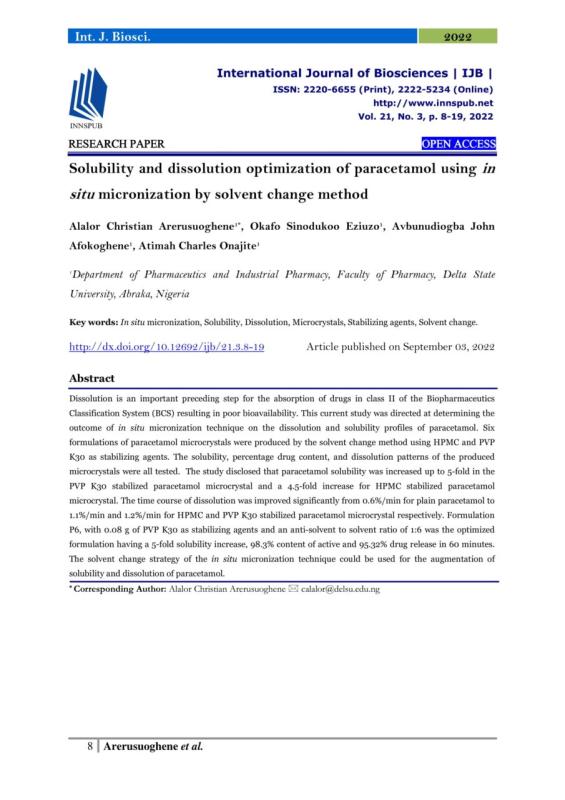
Solubility and dissolution optimization of paracetamol using in situ micronization by solvent change method | IJB 2022

Dissolution is an important preceding step for the absorption of drugs in class II of the Biopharmaceutics Classification System (BCS) resulting in poor bioavailability. This current study was directed at determining the outcome of in situ micronization technique on the dissolution and solubility profiles of paracetamol. Six formulations of paracetamol microcrystals were produced by the solvent change method using HPMC and PVP K30 as stabilizing agents. The solubility, percentage drug content, and dissolution patterns of the produced microcrystals were all tested.  The study disclosed that paracetamol solubility was increased up to 5-fold in the PVP K30 stabilized paracetamol microcrystal and a 4.5-fold increase for HPMC stabilized paracetamol microcrystal. The time course of dissolution was improved significantly from 0.6%/min for plain paracetamol to 1.1%/min and 1.2%/min for HPMC and PVP K30 stabilized paracetamol microcrystal respectively. Formulation P6, with 0.08 g of PVP K30 as stabilizing agents and an anti-solvent to solvent ratio of 1:6 was the optimized formulation having a 5-fold solubility increase, 98.3% content of active and 95.32% drug release in 60 minutes. The solvent change strategy of the in situ micronization technique could be used for the augmentation of solubility and dissolution of paracetamol.Author Name

Alalor Christian Arerusuoghene, Okafo Sinodukoo Eziuzo, Avbunudiogba John Afokoghene, Atimah Charles Onajite.

Journal Name 

International Journal of Biosciences | IJB

Publisher Name 

International Network For Natural Sciences | INNSpub

Abstract  

Dissolution is an important preceding step for the absorption of drugs in class II of the Biopharma ceutics Classification System (BCS) resulting in poor bioavailability. This current study was directed at determining the outcome of in situ micronization technique on the dissolution and solubility profiles of paracetamol. Six formulations of paracetamol microcrystals were produced by the solvent change method using HPMC and PVP K30 as stabilizing agents. The solubility, percentage drug content, and dissolution patterns of the produced microcrystals were all tested.  The study disclosed that paracetamol solubility was increased up to 5-fold in the PVP K30 stabilized paracetamol microcrystal and a 4.5-fold increase for HPMC stabilized paracetamol microcrystal. The time course of dissolution was improved significantly from 0.6%/min for plain paracetamol to 1.1%/min and 1.2%/min for HPMC and PVP K30 stabilized paracetamol microcrystal respectively. Formulation P6, with 0.08 g of PVP K30 as stabilizing agents and an anti-solvent to solvent ratio of 1:6 was the optimized formulation having a 5-fold solubility increase, 98.3% content of active and 95.32% drug release in 60 minutes. The solvent change strategy of the in situ micronization technique could be used for the augmentation of solubility and dissolution of paracetamol. Check out more by following the link Solubility and dissolution optimization of paracetamol using in situ micronization by solvent change method

DOI: http://dx.doi.org/10.12692/ijb/21.3.8-19

Reference


Amal AE, Ayobami J, Ebtessam E. 2012. In-situ controlled crystallization as a tool to improve the dissolution of glibenclamide. International Journal of Pharmaceutics 428, 118-120.

Brodka PK, Peter L, Peter G, Heribert H. 2003. Influence of mechanical activation on the physical stability of salbutamol sulphate. European Journal of Pharmaceutics and Biopharmaceutics 56, 393-400.

Buddha RS, Raja RP. 2009. Spectrophotometric Method for the Determination of Paracetamol.  Journal of Nepal Chemical Society 24(1), 520-525.

Chiou D, Langrish TAG. 2008. A comparison of crystallisation approaches in spray drying. Journal of Food Engineering 88, 177. http://dx.doi.org/10.1016/j.jfoodeng.2008.02.004

Daravath B, Naveen C, Vemula SK, Tadikonda RR. 2017. Solubility and dissolution enhancement of flurbiprofen by solid dispersion using hydrophilic carriers. Brazilian Journal of Pharmaceutical Sciences 53(04). http://dx.doi.org/10.1590/s217597902017000400010

Deelip D, Jatin P, Devendra Y, Amit P, Ashok P. 2010. Particle engineering techniques to enhance dissolution of poorly water-soluble drugs, International Journal of Current Pharmaceutical Research 2(1).

Devineni J, Harika T, Reddy K. 2015. Development of immediate-release liquid fill formulations for soft gels of paracetamol. International Journal of Pharmaceutical Development and Technology 5(1), 75-82.

European Pharmacopoeia. 2002. suppl. 4.1. Council of Europe, European Directorate for the quality of medicines, Strasbourg, Tablet monograph, 0478.

Fang Z, Jaakko A, Fang T, Dorothy JS, Thomas R. 2009. Influence of particle size and preparation methods on the physical and chemical stability of amorphous simvastatin. European Journal of Pharmaceutics and Biopharmaceutics 71(1), 64-70.

Filippos K, Yunhui WU. 2008. Understanding the effect of API properties on bioavailability through absorption modelling. Journal of the American Association of Pharmaceutical Scientists 10(4), 516-525.

Gibson M. 2001. Pharmaceutical pre-formulation and formulation – a practical guide from candidate drug selection to commercial dosage form. HIS Health Group, Englewood.

Irngartinger M, Camuglia V, Damm M, Goede J, Frijlink J. 2004. Pulmonary delivery of therapeutic peptides via dry powder inhalation: effects of micronisation and manufacturing. European Journal of Pharmaceutics and Biopharmaceutics 58, 7-14. http://dx.doi.org/10.1016/j.ejpb.2004.03.016

Jalay JT. 2011. A review on micronization techniques. Journal of Pharmaceutical Science and Technology 3(7), 651-681.

Kausalya J, Suresh K, Padmapriya S, Anusha R, Senthilnathan B. 2011. Solubility and dissolution enhancement of telmisartan using various techniques. International Journal of PharmTech Research 3, 1737–49.

Kawashima Y. 2001. Nanoparticulate systems for improved drug delivery. Advanced Drug Delivery Reviews 47, 1-2. http://dx.doi.org/10.1016/S0169-409X(00)00117-4

Kim ST, Kwon JH, Lee JJ, Kim CW. 2003. Microcrystallization of indomethacin using pH shift method. International Journal of Pharmaceutics 263 (1-2), 141-150. http://dx.doi.org/10.1016/S0378-5173(03)00358-2

Koennings S, Sapin A, Blunk T, Menei P,  Goepferich A. 2007.Towards controlled release of BDNF – manufacturing strategies for protein-loaded lipid implants and biocompatibility evaluation in the brain, Journal of Controlled Release 119, 163-172. http://dx.doi.org/10.1016/j.jconrel.2007.02.005

Leena P, Jouni H. 2010. Pharmaceutical nanocrystals by nanomilling: critical process parameters, particle fracturing and stabilization methods. Journal of Pharmacy and Pharmacology 62, 1569-1579.

Masoud B, Sima R. 2007. Production of micro-and nano-composite particles by supercritical carbon dioxide. Journal of Supercritical Fluids 40, 263-283.

Mattia C, Coluzzi F. 2009. What anesthesiologists should know about paracetamol (acetaminophen). Minerva Anestesiologica 75(11), 644-53.

Mauludin R, Muller RH, Keck CM. 2009. Development of an oral route nanocrystal formulation. International Journal of Pharmaceutics 370, 202-209.

Maximiano FP, Maria de Paula L, Figueiredo VP, Mayer de Andrade I, Talvani A, Sá-Barreto LC, Bahia MT, Cunha-Filho MSS. 2011. Benznidazole microcrystal preparation by solvent change precipitation and in vivo evaluation in the treatment of Chagas disease. European Journal of Pharmaceutics and Biopharmaceutics 78, 377–384. http://dx.doi.org/10.1016/j.ejpb.2011.03.003

Miranda A, Millan M, Carballo I. 2007. Investigation of the influence of particle size on the excipient percolation thresholds of HPMC hydrophilic matrix tablets. Journal of Pharmaceutical Sciences 96, 2746-2756. http://dx.doi.org/10.1002/jps.20912

Mullarney MP, Leyva N. 2009. Modelling pharmaceutical powder-flow performance using particle-size distribution data. Pharmaceutical Technology 33(2), 126-134.

Nighute AB, Bhise SB. 2009. Preparation and  Evaluation of Rifabutin Loaded Polymeric Microspheres. Research Journal of Pharmacy and Technology 2(2), 371-374.

Noor AD, Al-Khedairy EBH. 2019. Formulation and Evaluation of Silymarin as Microcrystals by In-Situ Micronization Technique. Iraqi Journal of Pharmaceutical Sciences 28(1). https://doi.org/10.31351/vol28iss1pp1-16

Pasquali I, Bettini R, Giordano F. 2006. Solid-state chemistry and particle engineering with supercritical fluids in pharmaceutics. European Journal of Pharmaceutical Sciences 27, 299-310. http://dx.doi.org/10.1016/j.ejps.2005.11.007

Rasenack N, Muller BW. 2002. Dissolution rate enhancement by in situ micronization of poorly water-soluble drugs. Pharmaceutical Research 19(12), 1894-1900.

Rasenack N, Muller BW. 2002. Ibuprofen crystals with optimized properties. International Journal of Pharmaceutics 245, 9-24.

Rasenack N, Muller BW. 2004. Micron-size drug particles: common and novel micronization techniques. Pharmaceutical Development and Technology 9(1), 1-13. http://dx.doi.org/10.1081/PDT-120027417

Rasenack N, Hartenhauer H, Muller BW. 2003. Microcrystals for dissolution rate enhancement of poorly water-soluble drugs. International Journal of Pharmaceutics   254, 137-145. http://dx.doi.org/10.1016/S0378-5173(03)00005-X

Rasenack N, Steckel H, Muller BW. 2004. Preparation of microcrystals by in situ micronization. Powder Technology 143-144, 291-296. http://dx.doi.org/10.1016/j.powtec.2004.04.021

Roya T, Varshosaz J, Mostafavi SA, Ali N. 2009. Dissolution enhancement of glipizide using pH change approach in the presence of twelve stabilizers with physic-chemical properties.  Journal of Pharmaceutical Sciences 12(3), 250-265.

Sharma P, Denny WA, Garq S. 2009. Effect of wet milling process on the solid-state of indomethacin and simvastatin. International Journal of Pharmaceutics 380 (1–2), 40-48. http://dx.doi.org/10.1016/j.ijpharm.2009.06.029

Simek M, Grünwaldová V, Kratochvíl B. 2016. Comparison of Compression and Material Properties of Differently Shaped and Sized Paracetamols. Powder and particle. http://dx.doi.org/10.14356/kona.2017003

Steckel H, Rasenack N, Muller BW. 2003. In-situ micronization of disodium cromoglycate for pulmonary delivery. European Journal of Pharmaceutics and Biopharmaceutics 55, 173-180. http://dx.doi.org/10.1016/S0939-6411(02)00168-6

Sunday AS, Simon C. 2006. Particle engineering techniques for inhaled biopharmaceuticals.  Advanced Drug Delivery Reviews 58, 1009-1029.

Sung TK, Jai-Hyun K, Lee JJ, Kim CW. 2003. Microcrystallization of indomethacin using pH shift method, International Journal of Pharmaceutical Research 263, 141-150.

Talari R, Varshosaz J, Mostafavi SA, Nokhodchi A. 2009. Dissolution Enhancement of Gliclazide using pH Change Approach in Presence of Twelve Stabilizers with Various Physico-Chemical Properties. Journal of Pharmacy and Pharmaceutical Sciences 12(3), 250-265.

Varshosaz J, Talari R, Mostafavi SA, Nokhodchi A. 2008. Dissolution enhancement of glipizide using in situ micronization by solvent change method. Powder Technology 187, 222-230.

Yohei K, Koichi W, Manabu N, Shizuo Y, Satomi O. 2011. Formulation design for poorly water-soluble drugs based on biopharmaceutics classification system: basic approaches and practical applications. International Journal of Pharmaceutics 420, 1-10.


August 2, 2022

Research Paper about Liming leads to high bean and maize yield on a strongly acid tea soil

Liming leads to high bean and maize yield on a strongly acid tea soil Acid soils are very common in tea zones.
 

Mr. Elisha Njue Mugai, and James Njer from the institute of the Department of Horticulture and Food Security, Jomo Kenyatta University of Agriculture and Technology, Nairobi, Kenya, and International Maize and Wheat Improvement Center (CIMMYT), United Nations Avenue, Gigiri, Village Market, Nairobi, Kenya wrote a research paper entitled "Liming leads to high bean and maize yield on a strongly acid tea soil" published by the International Journal of Agronomy and Agricultural Research | IJAAR, an affiliated journal of the International Network For Natural Sciences | INNSPUB, an open access scholarly research journal publishing company.

Abstract

Acid soils are very common in tea zones. These soils have a pH below 5.0. Below this pH, not only do the soils exhibit toxicity of aluminum and manganese but are deficient of calcium, magnesium, phosphorus and molybdenum, hence becoming chemically infertile. Liming is one cheap way of reclaiming these soils. The staple food crops in these tea soils are maize and beans. However the effect of different liming levels on bean (Phaseolus vulgaris L.) and maize (Zea maiys, L.) yield on acid tea-growing ando-humic Nitisol had not before been investigated. A study was therefore conducted to determine the crop response to liming and the appropriate liming level for maize and bean crops in a tea zone soils. The experiment was carried out in Embu County, Kavutiri and Kianjokoma areas, Agro-Ecological Zone (AEZ) UM1. A randomized complete block design with four replications of each lime treatment was used at each site. Lime at rates of 0 (L0), 2.4 (L1), 6 (L2), 8 (L3) t/ha was broadcasted on to 4m x 4m plots and mixed into 0-15cm of soil. There was a significant response to liming for both maize and beans. The maximum maize and beans yield was attained at around liming level L2 (pH 5.5). Above this pH, yields started to decline. The study clearly shows the benefits of soil liming on strongly acid tea soils and also the importance of accurate lime applications.


Liming leads to high bean and maize yield on a strongly acid tea soil

 Introduction

Strongly acid soils are very common in tea zones (Njeru et al., 2012). Soil is termed acidic when its pH goes below 5.5 (Sombroek, et al.,1984) . Below this pH value, the soil not only exhibits toxicity of aluminium (Al) and manganese (Mn) but also is likely to suffer deficiency of calcium (Ca), magnesium (Mg), phosphorus (P) and molybdenum (Mo), hence becoming infertile chemically (Von Uexküll and Mutert, 1995). Bean yield has been shown to reduce significantly as a result of this infertility (mugai et al., 2008). The application of high-input soil management technologies like expensive mineral fertilizers to increase food crop yields may not be feasible due to the low income levels of the farmers. Therefore the best approach should be a moderate input technology, like soil liming, which does not attempt to eliminate the use of fertilizers but rather complements them and maximizes their efficiency. Appropriate liming of acid soils eliminates Al toxicity, leads to supply of Ca andmg, and mobilises the fixed soil P and Mo (Njeru et al., 2012; Mugai, 2008). This leads to increased yields without even application of expensive mineral fertilizers or with low applications of phosphorus (P) and nitrogen (N) (Quaggio et al., 1995). On the other hand the effect of different liming levels on bean and maize yield on acid tea growing soil had not been investigated. It was therefore not possible to authoritatively recommend the lime level that could be applied in beans and maize crop in tea zones. The study was therefore conducted to determine the response and the appropriate liming level for maize and bean crops in a strongly acid tea zone soil. Check out more by following the link Liming leads to high bean and maize yield on a strongly acid tea soil

Strongly acid soils are very common in tea zones (Njeru et al., 2012). Soil is termed acidic when its pH goes below 5.5 (Sombroek, et al.,1984) . Below this pH value, the soil not only exhibits toxicity of aluminium (Al) and manganese (Mn) but also is likely to suffer deficiency of calcium (Ca), magnesium (Mg), phosphorus (P) and molybdenum (Mo), hence becoming infertile chemically (Von Uexküll and Mutert, 1995). Bean yield has been shown to reduce significantly as a result of this infertility (mugai et al., 2008). The application of high-input soil management technologies like expensive mineral fertilizers to increase food crop yields may not be feasible due to the low income levels of the farmers. Therefore the best approach should be a moderate input technology, like soil liming, which does not attempt to eliminate the use of fertilizers but rather complements them and maximizes their efficiency. Appropriate liming of acid soils eliminates Al toxicity, leads to supply of Ca andmg, and mobilises the fixed soil P and Mo (Njeru et al., 2012; Mugai, 2008). This leads to increased yields without even application of expensive mineral fertilizers or with low applications of phosphorus (P) and nitrogen (N) (Quaggio et al., 1995). On the other hand the effect of different liming levels on bean and maize yield on acid tea growing soil had not been investigated. It was therefore not possible to authoritatively recommend the lime level that could be applied in beans and maize crop in tea zones. The study was therefore conducted to determine the response and the appropriate liming level for maize and bean crops in a strongly acid tea zone soil.

Reference

Chapman HD, Pratt PF. 1961. Methods of analysis for soils, plants and waters. University of California, Los Angeles 60-61, 150-179.

FAO-Unesco. 1988. Soil map of the world. Revised legend, by FAO–UNESCO–ISRIC. World Soil Resources Report No. 60. Rome.

Hinga FN, Muchena, Njihiacm FN. 1980. Physical and Chemical Methods of Soil Analysis. National Agricultural Laboratories, MoA, Kenya.

Kenya Soil Survey (KSS). 2007. Soil Science Society of East Africa Excursion Route Guide, Embu, Kenya.

Mitchell CC. 1999. Soil Acidity and Liming (Overview), Department Crop and Soil Environmental Science,Clemson University. Available online at: http://hubcap.clemson.edu/~blpprt/pdf

Mugai EN, Agong SG, Matsumoto H. 2008. The effect of liming an acid nitisol with either calcite or dolomite on two common bean (Phaseolus vulgaris L.) varieties differing in aluminium tolerance. Journal of Agriculture Science and technology, 10(2), 9-34.

Njeru MJ, Mugai EN, Njoroge G, Nyende AB. 2012. The impact of liming on biodiversity in Embu tea zone landscapes: A case study of Kavutiri area. Afr. J. Hort. Sci 6, 61-71.

Quaggio JA, Teófilo Sobrinho J, Dechen AR. 1992. Response to liming of ‘Valencia’ orange tree on Rangpur lime: effects of soil acidity and plant growth and yield. Proceedings of the International Society of Citriculture 2, 623-632.

Soil Survey Staff – USDA. 1999. Soil taxonomy: A basic system of soil classification for making and interpreting soil surveys. 2nd edition. Natural Resources Conservation Service. U.S. Department of Agriculture Handbook 436.

Sombroek WG, Braun HMH, Van der Pouw BJA. 1984. Exploratory Soil Map and Agro-climatic Zone Map of Kenya. Kenya Soil Survey. MoA, Kenya.

Tessens E, Shamshuddin J. 1982. Characteristics related to charges in oxisols of peninsular Malaysia. Pedologie XXXII (1), 85-106.

Von Uexkull, HR, Mutert E. 1995. Global extent, development and economic impact of acid soils. Plant and Soil 171, 1-15.

Warren GP, Kihanda FM. 2001. Nitrate leaching and adsorption in a Kenyan Nitisol. Soil Use and Management 17, 222-228.


June 25, 2022

Levers for the transformation of land use on the periphery of the Haut-Sassandra classified forest | JBES 2021


Fig. 1. Maps of land cover at the periphery of the classified forest of Haut-Sassandra in 1997, 2002, 2006, 2013 and 2018.

Research Paper was developed by Mr. Barima Yao Sadaiou Sabas, Zanh Golou Gizèle, Kouakou Akoua Tamia Madeleine, and Mr. Kouakou Kouassi Apollinaire from the institute of the Environmental Training and Research Unit, Jean Lorougnon Guédé University, Daloa, Ivory Coast, Published by the Journal of Biodiversity and Environmental Sciences | JBES, under the publication of the International Network For Natural Sciences | INNSPUB. Let's get some knowledge about it.

Abstract

The development of the agricultural sector in Côte d’Ivoire has led to profound changes in forest cover in general and around the protected areas of the State in particular. The aim of this work is to give an account of the process of mutation of the rural space of the classified forest of Haut-Sassandra for a better conservation of the latter. To achieve this objective, satellite images dating from 1997, 2002, 2006, 2013 and 2018 have been classified followed by observations and field surveys. The results show a reduction in forest cover in favour of agriculture. In fact, the forested areas that occupied 18.4% of the landscape in 1997 fell to 4% in 2018 with a conversion of more than 80% of the forested areas to crops. The latter are dominated by three perennial crops with associated food crops. Among these perennial crops, cocoa and coffee are the old ones and are essentially cultivated on a forest cultivation precedent, thus leading to a rarefaction of forest areas. While cashew trees, the third perennial crop, are more recent and were introduced into the area as a result of the increasing scarcity of forest areas. Thus, cashew trees are essentially cultivated on previous crops grown on fallow land and old plantations.

Journal Name- Journal of Biodiversity and Environmental Sciences | JBES

Published By- International Network for Natural Sciences | INNSPUB

Introduction

Agriculture plays a key role in the economic development of Sub-Saharan African countries. In these countries, it accounts on average for 70% of total employment, 40% of export goods and one-third of Gross Domestic Product (GDP) (Esso, 2009). Thus, among these sub-Saharan African countries, Ivory Coast has focused its economic development on the agricultural sector since independence. This sector is the engine of Ivorian growth with the development of cash crops encouraged by the State. According to the economic statistic, agriculture provides about 40% of Ivory coast export earnings and contributes to 15% of Gross Domestic Product (GDP) (Assiri et al., 2016). However, agricultural pratices led a drastic reduction in forest cover (Koffi et al., 2018). Ivorian forest, which represented about 16 million hectares in 1960, has undergone a rapid reduction in area to less than 2.5 million hectares in 2007 (Chatelain et al., 2004). 

Agricultural activities are pointed out in Ivory coast as the main driver of deforestation (Desdoigts and Kouadio, 2013 ; Cissé et al., 2016). This is leading to the depletion of forest reserves (Kassin, 2009). Faced with this depletion of forest reserves, a displacement of populations from the pre-forest areas of the Center to forest areas including the Center-West of Ivory Coast in search of land suitable for cocoa production is observed. Furthermore, the displacement of populations in the Center-West of Ivory Coast has increased pressure on the land resources still available and the emergence of inter-community conflicts. Pressure on these resources has increased in both protected and rural areas (Ruf, 2018). 

The rural area of the Haut-Sassandra classified forest (CFHS) has experienced a massive displacement of population mainly from central Ivory Coast and Burkina Faso, in search of land suitable for cocoa production (Kouakou et al., 2015), increasing land and forest pressures. Once settled, these populations set up large camps (Oswald, 2005). In the face of these pressures on land and forest resources, monitoring and quantification of the dynamics of land use in the CFHS rural area is relevent in order to inform These natural resources management. Thus, the present study aims to determine the processes of transformation of the rural space of the classified forest of Haut-Sassandra for a better conservation of the latter. Indeed, the classified forest of Haut- Sassandra was declared a permanent domain of the Ivorian state in 1969 (Kouamé, 1998). This forest has been described as a dense semi-deciduous forest with Celtis spp. and Triplochiton scleroxylon (K. Schum, from the mesophilic sector within the Guinean domain (Guillaumet and Adjanohoun, 1971). 

The flora of the CFHS is highly diversified both at the generic and specific levels (Kouamé, 1998). In 1998, it contained 1047 species composed of several endemic species with special IUCN status. Thus, it accounted for 25% at the species level and 43% at the genus level of the general flora of Ivory Coast (Kouamé et al., 1998). This state-owned area has experienced and continues to experience strong anthropogenic pressure (Kouakou et al., 2018; Kouakou et al., 2017). To date, forest area has decreased by more than 50%, with an annual loss of 17% to crops and housing (Barima et al., 2016, Kouakou et al., 2015; Sangne et al., 2015). This degradation of the CFHS could be the result of the anthropization of its periphery. The identification and understanding of the drivers of the modification of the peripheral areas of the CFHS could allow a better understanding of the pressures exerted in the protected area and guide the manager's decision-making. Check out more J. Bio. Env. Sci. 18(3), 70-85.