August 6, 2023

Design and Modification of Compost Bin with a Chopper | An Open Access Research Paper By IJB

Design and Modification of Compost Bin with a Chopper for 3R (Reduce, Reuse, Recycle) Temporary Shelter (TPS 3R) in Banjar Regency South Kalimantan
Compost Bin Design.

Author's

Rizqi Puteri Mahyudin, Muhammad Reynaldi Faradil Rakhim, Noriana Apriana, Muhammad Abrar Firdausy, Andy Mizwar, Yuni Safaria Dwi Lestari, and Bambang Joko Priatmadi

Journal Name

International Journal of Biosciences | IJB

Publisher Name

International Network For Natural Sciences | INNSpub

Abstract

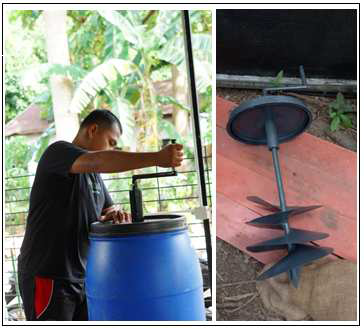
Composting is an effective method of managing organic waste from decomposition by microorganisms. This research using composting technique with a modification compost bin with additional chopper on the top of the bin. The composter was designed using an HDPE drum with a height of 100 cm and a diameter of 50 cm with the addition of a chopper and a manual compost mixer as well as a lower cross-section. This research aimed to calculate the amount and composition of waste in TPS 3R Sekumpul and to design modification of a compost bin to handle the problem of organic waste in TPS 3R Sekumpul. The average waste generation in TPS 3R Sekumpul is 66,875 kg/day with the composition of the waste generated including compostable (organic) at 4.28%, resaleable waste at 93.85%, and residual waste at 1.87%. The manual chopper is designed with 7 blades with a slope of 45° which are placed on an iron plate connected to a handle to rotate the chopper. The rotate is in the form of a spiral attached to the rotate handle and connected to the drum cover and the bottom section is a rectangular metal structure having 4 wheels on each side. All of the tools that are designed and made can work smoothly without being constrained during the testing of the tool. The composter drum can accommodate up to 25 kg of compost and leachate in the lower part of the compost bin partition. Assessment of the performance of the compost bin with a chopper is seen from the results of the chopped organic waste produced from the chopper. In the knife chopper test using 5 kg of organic waste, the chopped waste results were obtained with an average size is between 0.5 cm – 1 cm. Compost bin with chopper are designed so that they are easy to operate for households and regional scales. It is expected that the use of the compost bin can facilitate the user so that compost is produced with good quality, large quantity and fast composting time.

Submit your manuscript to the International Journal of Biosciences

Introduction

Composting activity is an alternative choice in organic waste management using a composter with a decomposition process. With the help of microorganisms on biodegradable organic waste with the final result in the form of humus (Gonawala & Jardosh, 2018). There are two composting methods, namely aerobic and anaerobic processes. The use of a drum composter in the composting method is included in aerobic composting. The use of a drum that has been modified into a composter tool and used in organic waste composting activities in an area will help significantly reduce the amount of waste in a landfill (Manu et al., 2016). In utilizing organic waste in Banjar Regency, the composting method is an alternative that can be applied to convert organic waste into compost.

Indonesia, which is a developing country, is recorded to produce twice the amount of organic waste generation (food waste), which is 50 - 80% of the total municipal waste generation. Compared to the current three developed countries, Japan produces the highest organic waste generation, which is only 40%, followed by the European Union at 34%, and the USA at 24% organic waste generation from the total waste generation (Dalankopoulos et al., 1998)). For this reason, an organic waste management effort is needed which starts with micro-scale management at various points in the territory of the country of Indonesia to help reduce and deal with the problem of organic waste generation in Indonesia.

The discussion regarding Waste Management and TPS Facilities is contained in Law no. 18/2008, 3R (Reduce, Reuse, Recycle) Temporary Shelter (TPS 3R) is a place where activities to collect, sort, reuse, and recycle waste on a regional scale (Nurlela, 2017). Waste that is generated will go into the first processing site, namely the Temporary Shelter – Tempat Penampungan Sementara (TPS). TPS is a place where waste is transported before it is moved to either the recycling site, processing site, Integrated Waste Processing Site – Tempat Pemrosesan Sampah Terpadu (TPST), or 3R Waste Management (TPS 3R) site. 

Composting municipal waste allows the organic material contained in the waste to be returned to the soil so that the level of soil fertility is maintained because of the addition of organic material as a substitute for material absorbed by cultivated plants. Household-scale composting technology with several considerations such as placement can be done indoors and outdoors, resistant to heat and rain, has a longer shelf life, does not need to replace supporting materials (cardboard), and is easier get the composter container (Wahyono et al., 2016). Some of the obstacles in composting include still using the manual method (Antu & Djamalu, 2019). In addition, there are obstacles in the long composting time due to the large size of the organic waste. The smaller the size of the organic waste, the faster the decomposition will be. Designing a composter with a manual chopper can be a solution to simplify household and communal scale composting such as TPS 3R.
Design and Modification of Compost Bin with a Chopper for 3R (Reduce, Reuse, Recycle) Temporary Shelter (TPS 3R) in Banjar Regency South Kalimantan

In this design, the development and improvement of the compost bin design was carried out in the three previous studies, namely by adding a compost mixer and improvements to the designs of Purba (2021) and Akhmad (2020) by making a bottom section of the composter bin as in the design of Tjahjani et al. (2008). The addition of a compost mixer in the compost bin is to help the mixing of the compost easier. Improvements to the chopper tool from Purba's research (2021) were also carried out because there were still many deficiencies, the majority of the chopped organic waste results were still not up to standard.

Design and Modification of Compost Bin with a Chopper for 3R (Reduce, Reuse, Recycle) Temporary Shelter (TPS 3R) in Banjar Regency South Kalimantan

This research will develop the design of Compost Bin that have made in 2021 (Mahyudin et al., 2022) in order to produce tools that are easier to operate. The communal composter will process organic waste from several households to be composted. This composter is designed in such a way that it is easy to operate on a regional scale. Furthermore, testing the performance of the composter will be carried out so that later a variation will be produced that can produce compost with good quality, large quantity and fast composting time.

Design and Modification of Compost Bin with a Chopper for 3R (Reduce, Reuse, Recycle) Temporary Shelter (TPS 3R) in Banjar Regency South Kalimantan

The urgency of this research lies in the innovative development of Compost Bin design with a chopper which is easier to operate on a regional scale and produces good quality compost that can be used or sold. This research was conducted for identifying the amount and composition of the waste that entering TPS 3R; also to designing a developed Compost Bin with a modification of the chopping knife to process organic waste into compost?

 Check out more Design and Modification of Compost Bin with a Chopper for 3R (Reduce, Reuse, Recycle) Temporary Shelter (TPS 3R) in Banjar Regency South Kalimantan

Reference

Akhmad A. 2020. Perancangan. Komposter. Sebagai. Unit.Pengolahan Sampah Pasar. Universitas Pertamina.

Gonawala SS, Jardosh H. 2018. Organic Waste in Composting: A brief review. International Journal of Current Engineering and Technology 8(1), 36-38.

IPCC. 2006. IPCC 2006 Guidelines for National Greenhouse Gas Inventories. Prepared by the National Greenhouse Gas Inventories Programme, Eggleston H.S., Buendia L., Miwa K., Ngara T. And Tanabe K. IGES: Japan.

Mahyudin RP, Purba G, Lestari YSD, Firmansyah M. 2022. Design of Household Organic Waste Composter Bins “Tongposcah”. 9 (January), 630–634. https://doi.org/10.52403/ijrr.20220173

Manu MK, Kumar R, Garg A. 2016. Drum Composting of Food Waste: A Kinetic Study. Procedia Environmental Sciences 35, 456–463.

Nurlela N. 2017. Dampak Keberadaan Tempat Pengolahan Sampah 3R (Reduce, Reuse, Dan Recycle) Vipa Mas Terhadap Lingkungan Sosial Ekonomi Masyarakat Di Kelurahan Bambu Apus Kecamatan Pamulang Kota Tangerang Selatan. Universitas Islam Negeri (UIN) Syarif Hidayatullah.

Purba G. 2021. Tugas. Akhir. Perancangan. Tongposcah (Tong Komposter Pencacah) Sampah Organik Rumah Tangga. Universitas Lambung Mangkurat.

Republik Indonesia. 2008. Undang-Undang.Republik.Indonesia Nomor 18 Tahun 2008 Tentang Pengelolaan Sampah. Sekretariat Negara. Jakarta. 1–46.

Antu ES, Djamalu Y. 2019. Desain Mesin Pencacah Sampah Organik Rumah Tangga Untuk Pembuatan Pupuk Kompos. Jurnal Teknologi Pertanian Gorontalo (JTPG) 3(2), 57-65. https://doi.org/10.30869/jtpg.v3i2.247

Sunge R, Djafar R, Antu ES. 2019. Rancang Bangun Dan Pengujian Alat Pencacah Kompos Dengan Sudut Mata Pisau 45°. Jurnal Teknologi Pertanian Gorontalo (JTPG), 4(2), 62–70.

Tjahjani IK, Wignjosoebroto S, Ciptomulyono U. 2008. Perancangan Sistem Pengolahan Sampah Organik Dengan Inovasi Komposter Yang Ergonomis Menggunakan Metode Quality Function Deployment (QFD). Prosiding Seminar Nasional Manajemen Teknologi VIII, 2–12.

Wahyono S, Widanarko S, Moersidik SS, Djajadiningrat ST. 2016. Metabolisme Pengelolaan Sampah Organik Melalui Teknologi Komposting Di Wilayah Internal Perkotaan. Jurnal Teknologi Lingkungan, 13(2), 179. https://doi.org/10.29122/jtl.v13i2.1417


June 10, 2023

Phytoremediation potential of Centella asiatica (gotu kola) in nickel ore-contaminated soils | JBES 2018

Phytoremediation potential of Centella asiatica
Map showing the operating nickel mining sites in Carrascal, Surigao del Sur, Philippines.

Author Information

Genelyn G. Madjos from the Institute of the Department of Biological Sciences, College of Science and Mathematics, Western Mindanao State University, Zamboanga City, Philippines

Journal Name

Journal of Biodiversity and Environmental Sciences | JBES

Abstract

Nickel miningposed a serious environmental problem due to run-offs and tailings. To address this, current techniques include excavation, chemical stabilization and soil flushing, but these methods are costly and impractical. One of the ecologically accepted treatments is phytoremediation. With the capacity of Centella asiatica (gotu kola) to thrive in moist soils with domestic effluents, this present study sought to evaluate its phytoremediation potential by employing an experimental design with three replicates of: (a) nickel-rich bio-ore soils from the mining site in Carrascal, Surigao del Sur as treatment substrates; and (b) natural background soils from Iligan City as the control substrate). Phytoremediation potential of C.  asiatica was assessed through relative plant growth, bioaccumulation capacity through Atomic Absorption Spectrometer (AAS), contamination factor (CF) computationand tolerance-accumulating mechanism through SHAPE software tool which evaluates shape variations based on elliptic Fourier descriptors. Results reveal relative growth values close to 1 which means that they have the potential to survive in nickel-contaminated condition. AAS results show a greater decrease in soil nickel content and a bigger increase in nickel accumulation in the plant samples in the nickel-ore contaminated soils than in the background (control soils). Contamination factor values indicate that soil and plant samples have very high contamination factor (6 < CF). SHAPE analysis between the control and treatment set-up shows no variations (p= 0.155) in the leaf shape of C. asiatica which indicates its tolerance-accumulating mechanism. These concerted results suggest that C. asiatica may exhibit phytoremediation potential in nickel-ore contaminated soils.

Submit your paper to JBES by INNSpub

Introduction


Phytoremediation potential of Centella asiatica (gotu kola) in nickel ore-contaminated soils
Nickel contamination is a very important environmental problem though, the fact remains that it is extremely difficult to remediate the heavy-metal contaminated soils. Current techniques used to remediate heavy-metal contaminated soils include excavation, chemical stabilization, soil washing or soil flushing, but these methods are costly and impractical (Mehes-Smith et al., 2013). Phytoremediation is an ecologically acceptable process and cost-effective use of hyper-accumulator plants to remediate contaminated soils (Lone et al., 2008; Sharma et al., 2013). Centella asiatica (gotu kola) is a small, herbaceous plant usually seen in shady and moist areas and can even thrive abundantly in canals with domestic effluence. 

Phytoremediation potential of Centella asiatica (gotu kola) in nickel ore-contaminated soils
In the context of phytoremediation, it was reported to be accumulate copper, lead, and zinc in contaminated media (Yap et al., 2010; Mokhtar et al., 2011a,b;Bahnika&Baruah 2014;). This, however, is still a less studied plant in the field of phytoremediation, especially in the case of nickel. Carrascal nickel mining sites in Surigaodel Sur, Mindanao, Philippines is one of the worlds’ largest producers of nickel (US Geological Survey, 2015). Current mining operations are all conducted above ground however; reported nickel mobility includes erosion and run-offs through river systems, estuaries and finally oceans, the ultimate sink. 

It can also enter groundwater supplies by leaching through the soil column. Soils in agricultural areas are becoming inappropriate for sustainable agriculture due to siltation which leads to phytotoxicity (NSCEP-EPA, 1990). With this present condition, this study sought to evaluate the possibility of using Centella asiatica (gotukola) for phyto-remediating nickel-rich bio-ore contaminated soils though an experimental design. Check out more Phytoremediation potential of Centella asiatica (gotu kola) in nickel ore-contaminated soils

Reference

Aartri C, Sanjeeda I, Maheshwari RS, Bafna A. 2012. Study of heavy metal accumulations and relative effects on total photosynthetic pigments in plant leaves growing in Pithampur Industrial Area Sector-1, 2 and 3, India. Journal of Environmental Research and Development 7(2A), 979-985.

Agunbiade FO, Fawale AT. 2009. Use of Siam weed biomarker in assessing heavy metal contaminations in traffic and solid waste polluted areas. International Journal of Environmental Science and Technology 6(2), 267-276.

Ahemad M. 2014.Remediation of metalliferous soils through the heavy metal resistant plant growth promoting bacteria: Paradigms and prospects. Arabian Journal of Chemistry 1-13. http://dx.doi.org/10.1016/j.arabjc.2014.11.020

Ahmad MS, Ashraf M. 2011.Essential roles and hazardous effects of nickel in plants.Reviews of Environmental Contamination and Toxicology 214, 125-167. http://dx.doi.org/10.1007/978-1-4614-0668-6_6.

Aurangzeb N, Nisa S, Bibi Y, Javed F, Hussain F. 2014. Phytoremediation potential of aquatic herbs from steel foundry effluent. Brazilian Journal of Chemical Engineering 31(4), 881–886. http://dx.doi.org/10.1590/01046632.20140314s00002734

Brown PH, Welch RM, Cary EE. 1987. Nickel: A Micronutrient Essential for Higher Plants. Plant Physiology 85, 801-803. https://doi.org/10.1104/pp.85.3.801

Bahnika S, Baruah P. 2014. Heavy Metal Extraction Potentiality of Some Indigenous Herbs of Assam, India. Journal of Environmental Research and Development 8(3A), 633-638.

Chandran S, Niranjana V, Joseph B. 2012. Accumulation of heavy metals in wastewater irrigated crops in Madurai, India. Journal of Environmental Research and Development 6(3), 432-438.

Das S, Shil P. 2012. Phytoremediation: A cost-effective clean up technique for soil and groundwater contaminants. Journal of Environmental Research and Development 6(4), 1087-1091.

Elekes CC. 2014. Assessment of Historical Heavy Metal Pollution of Land in the Proximity of Industrial Area of Targoviste, Romania. INTECH Chapter 8, p. 257-284.

Favas P, Pratas J, Varun M, Souza R, Paul M. 2014. Phytoremediation of Soils Contaminated with Metals and Metalloids at Mining Areas: Potential of Native Flora. Environmental Risk Assessment of Soil Contamination. INTECH Chapter 17, p 485–517.

Garbisu C, Alkorta I. 2001. Phytoextraction: A cost-effective plant-based technology for the removal of metals from the environment. Bioresource Technology 77(2), 229–236.

Ghosh M, Singh SP. 2005. A review on phytoremediation of heavy metals and utilization of its byproducts. Applied Ecology and Environmental Research 3(1), 1-18.

Hall J. 2002. Cellular mechanisms for heavy metal detoxification and tolerance. Journal of Experimental Botany 53, 1-11.

Hammer O, Harper DAT, Ryan PD. 2001. PAST: paleontological statistics software package for education and data analysis. Palaeontologia Electronica 4(1), 1-9.

Iwata H, Ukai Y. 2002. SHAPE: a computer program package for quantitative evaluation of biological shapes based on elliptic Fourier descriptors. Journal of Heredity 93(5), 384-385. http://dx.doi.org/10.1093/jhered/93.5.384

Joaquino A, Piñero D, Echem R, Ascaño C, Torres MAJ. 2017. Outline-based Analysis of Sexual Dimorphism in the Shell of the Freshwater Mussel (Margaritifera margaritifera L.). Journal of Biodiversity and Environmental Sciences 10(3), 43-49.

Kuhl FP, Giardina CR. 1982. Elliptic Fourier features of a closed contour. Computer Graphics and Image Processing 18(3), 236-258.

Lone MI, He Z, Stofella PJ, Yang X. 2008. Phytoremediation of Heavy Metal Polluted Soils and Water: Progresses and Perspectives. Journal of Zhejiang University Science B. 9(3), 210-220.

Magrini S, Scoppola A. 2010. Geometric morphometrics as a tool to resolve taxonomic problems: the case of Ophioglossum species (ferns). In: Nimis P. L., Vignes Lebbe R. (eds.) Tools for Identifying Biodiversity: Progress and Problems, p 251-256.

Mehes-Smith M, Nkongolo K, Cholewa E. 2013. Coping Mechanisms of Plants to Metal Contaminated Soil. Environmental Change and Sustainability. INTECH Chapter 3, 53-90.

Mokhtar H, Morad N, Fizri F. 2011a. Phytoremediation of copper by Centella asiatica and Eichhornia crassipes. International Journal of Environmental Science and Development 2(3), 205-210.

Mokhtar H, Morad N, Fizri F. 2011b. Hyper accumulation of Copper by Two Species of Aquatic Plants.International Conference on Environment Science and EngineeringIPCBEE, IACSIT Press, Singapore 8, p 115-118.

National Service Centers for Environmental Publications-Environment Protection Agency (NSCEP-EPA). 1990. Health Assessment Document for Nickel and Nickel Compounds Final Report,  p.1.

Occupational Exposure to Hazardous Chemicals in Laboratories. 1998 Code of Federal Regulations, Part 1910.1450, Title 29.

Official Method of Analysis of AOAC International, 2012.19th ed., Accessed at: www.eoma.aoac.org

Quian JH, Zayed A,  Zhu YL, MeiYu TN. 1999. Phytoaccumulation of trace elements by wetland plants: III. Uptake and accumulate of ten trace elements by twelve plant species.  Journal of Environmental Quality 28(5), 1448-1456.

Rai PK. 2009. Heavy Metal Phytoremediation from Aquatic Ecosystems with Special Reference to Macrophytes, Critical Reviews in Environmental Science and Technology 39(9), 697-753.

Robinson BH. 1997. The Phytoextraction of heavy metals from metalliferous soils. PhD Thesis. Massey University, New Zealand, p 1-145.

Sharma HK, Dogra P, Sharma N, Sharma S. 2013. Comparative Study on Phytoremediation of Synthetic and Industrial Effluent. Research Journal of Recent Sciences 2, 261-267.

United States (US) Geological Survey 2015. Accessed at: www.usgs.gov

Wardiyati T, Maghfoer MD, Handayanto E. 2013. Bioaccumulation of nickel by five wild plant species on nickel-contaminated soil. IOSR Journal of Engineering 3(5), 1-6.

Wei S, Zhou Q, Wang X. 2005. Identification of weed plants excluding the uptake of heavy metals. Environment International 31, 829-834.

Yap CK, Mohd Fitri MR, Mazyhar Y, Tan SG. 2010. Effects of metal contaminated soils on the accumulation of heavy metals in different parts of Centella asiatica: A Laboratory Study. Sains Malaysiana 39(3), 347-352.